
Omnichannel Experience Optimization for BOPIS
Scaled Claire’s eCommerce to meet Gen Z & Gen Alpha expectations through seamless omnichannel experiences like BOPIS.
Role: Improve the BOPIS discovery and checkout experience, reduce friction in product discovery by location, and create a simpler path from online browsing to store pickup.
My role was to improve the BOPIS discovery and checkout experience, reduce friction in product discovery by location, and create a simpler path from online browsing to store pickup.
Impact
Reduced navigation friction
Improved product discovery by location
Created a scalable responsive UX framework across devices
Validated improvements through moderated user testing.
Problem Statement
As Claire’s expanded omnichannel services, customers struggled to complete the online-to-store journey efficiently.
Location-based filtering was difficult
Users struggled to find products available in nearby stores.
Too many navigation steps
The journey from product search → store selection → checkout was fragmented.
Mobile experience lacked clarity
Navigation and filtering did not scale well across devices.
Low visibility of BOPIS option
Users were unsure whether items were available for in-store pickup.
These friction points created drop-off in the product discovery and checkout stages.
Requirement gathering

Stakeholder Interviews
Aligned product, marketing, and engineering teams around:
BOPIS adoption goals
Store inventory visibility
Checkout conversion targets
Key Insight
Users think in terms of nearby stores, not SKU inventory systems. The experience needed to shift from product-first to location-aware browsing.
Business Goal
Increase eCommerce conversion and drive in-store revenue by enabling seamless discovery of nearby inventory and a frictionless same-day pickup (BOPIS) experience.

Optimization
Organic traffic, trends, organic keywords, backlinks firing to your site.
User Testing

User Testing
Moderated 1:1 usability tests using UserZoom / Validately to observe:
Product discovery behavior
Store filtering issues
checkout drop-off points
Design Trade Offs
1. Feature Density vs. User Focus
The Tradeoff: Comprehensive filtering options vs. a streamlined search experience.
The Decision: Prioritize Core Utilities. We will limit initial filters to Location and Availability.
The Goal: Reduce cognitive load and friction for the majority of users who are primarily looking for immediate fulfillment nearby.
2. Data Integrity vs. System Performance
The Tradeoff: Absolute real-time inventory accuracy vs. rapid page load speeds.
The Decision: Optimistic UI with Status Messaging. We will prioritize speed by using cached data and clear status indicators (e.g., "In Stock," "Limited Quantities") rather than forcing a heavy real-time sync for every SKU on every page load.
The Goal: Keep the browsing experience fluid while managing user expectations regarding stock levels.
3. Mobile Depth vs. Screen Real Estate
The Tradeoff: Displaying full functionality vs. maintaining a clean mobile interface.
The Decision: Progressive Disclosure. Complex features and secondary information will be tucked behind "Show More" interactions or contextual menus.
The Goal: Prevent "choice paralysis" on small screens and ensure the primary conversion path remains unobstructed.
Experience Design

Prototype & Validation
Created interactive prototypes of the new flow and tested them with users.
Testing validated:
Faster store filtering
Higher task completion rates
Reduced confusion around pickup availability
Page Navigation: Improved User eXperience by improving page navigation
User feedback informed iterative improvements before implementation.
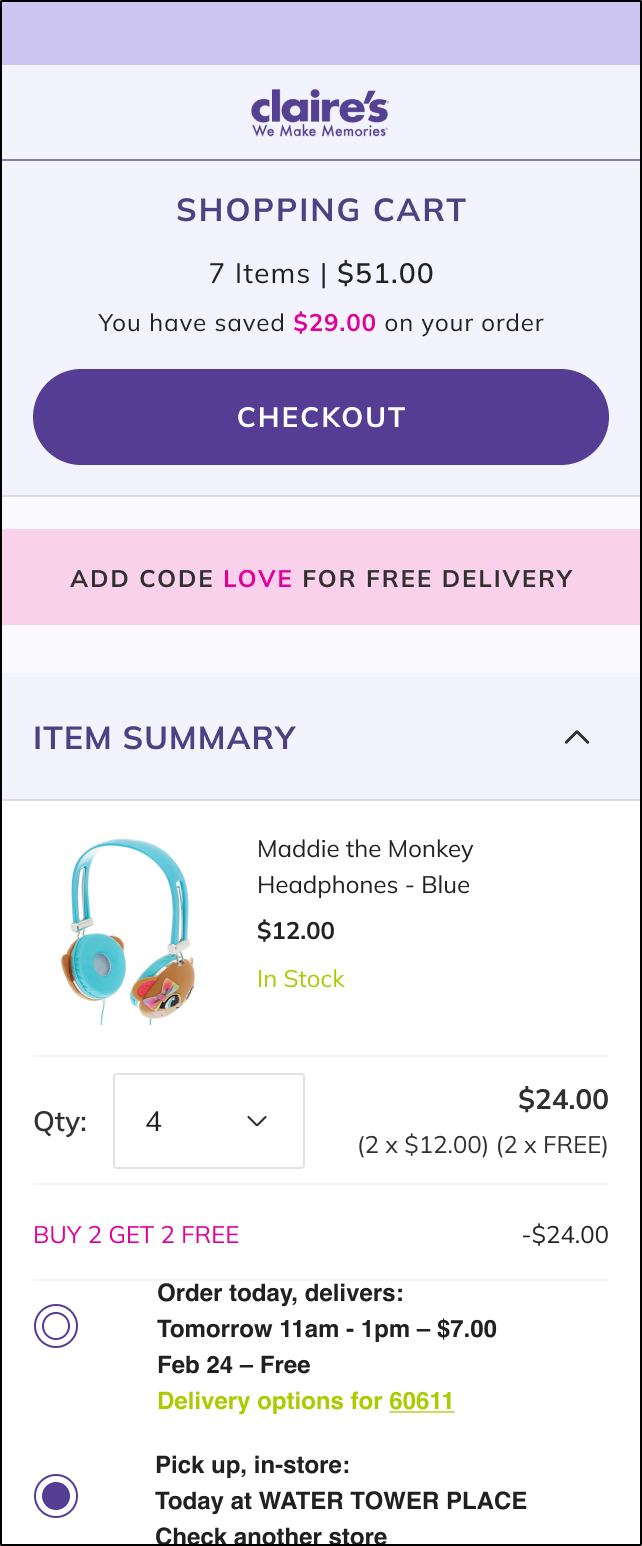
Location-Based Filtering: Users can easily filter products by nearby stores.
Benefits:
Faster product discovery
Real-time inventory awareness
Simplified Navigation: Reduced steps across the journey:
Old flow
Search → Product → Store → Checkout
New flow
Search → Product + Store Availability → Checkout
Responsive UX System: Created consistent experiences across:
Mobile
Tablet
Desktop
This ensured the same BOPIS flow works across devices.

UX Metrics & Success Measurement
Customer Experience
Task completion rate
Time to find product in nearby store
User satisfaction score
Business Metrics
BOPIS adoption rate
Checkout conversion rate
Store pickup revenue
Impact
The redesign created a foundation for omnichannel retail experiences.
Benefits for the business:
Improved online-to-store conversion
Reduced friction in product discovery
Scalable UX system for future features
This work helped Claire’s evolve toward a more integrated digital + physical retail experience, an increasingly critical capability as retailers expand omnichannel strategies.
The Future opportunities:
1. Real-time store inventory: Integrate POS systems for more accurate availability.
2. Personalized store recommendations: Use location and purchase history.
3. Appointment-based services: Extend BOPIS flows to services like ear piercing.